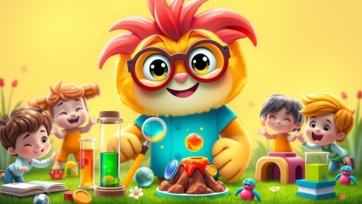
Introducing children to science at an early age helps spark curiosity, creativity, and problem-solving skills. Science for kids – animated experiments and fun facts is a fun and engaging way to teach complex scientific concepts in a simple, understandable, and entertaining format. Through colorful animations, interactive visuals, and playful characters, children can learn about science while having fun. This article explores why animated science videos are effective, their educational benefits, and how parents can use them to encourage a love for science.
⭐ Why Animated Science Videos Are Effective for Kids:
Animated science experiments and fun facts are ideal for young learners because they combine visual learning, interactivity, and entertainment:
1. Visual Representation of Complex Ideas:
Science concepts like gravity, magnets, or chemical reactions can be hard for children to grasp. Animations simplify these ideas through bright visuals and step-by-step demonstrations.
2. Engaging and Interactive:
Cartoons and animations keep children interested and encourage participation. Many videos ask kids to guess outcomes or make predictions, making learning active.
3. Memorable Learning:
Fun characters, storytelling, and humor make scientific concepts stick in children’s minds longer than traditional teaching methods.
4. Safe Experiment Demonstrations:
Animated experiments allow children to see exciting experiments without any risk of harm, chemicals, or accidents.
5. Encourages Curiosity:
Animated science videos spark curiosity and inspire children to ask questions, explore, and conduct safe experiments at home or in school.
⭐ Popular Themes in Science for Kids Videos:
1. Simple Experiments:
Animated experiments show easy, safe science projects like mixing colors, creating volcanoes, or floating objects, which children can try at home with parental guidance.
2. Fun Science Facts:
Videos share amazing facts about space, animals, plants, weather, or the human body in a fun, animated format that captures attention.
3. Everyday Science:
Cartoons explain scientific principles in daily life, such as why it rains, how plants grow, or how magnets work, making learning relatable.
4. Adventure-Based Learning:
Characters go on exciting science adventures, exploring the ocean, outer space, or the rainforest, combining storytelling with scientific discovery.
5. Interactive Quizzes and Challenges:
Animated quizzes challenge kids to test their knowledge, solve puzzles, or predict experiment outcomes, reinforcing learning and critical thinking.
⭐ Educational Benefits of Science for Kids Videos:
1. Develops Scientific Thinking:
Children learn to observe, hypothesize, experiment, and draw conclusions, laying the foundation for scientific thinking.
2. Boosts Curiosity and Exploration:
Animated science encourages children to ask questions and explore the world around them creatively.
3. Improves Cognitive Skills:
Watching animated experiments develops memory, attention, problem-solving, and analytical skills.
4. Enhances Language and Communication:
Narration and dialogues in videos improve vocabulary, listening skills, and comprehension of scientific terms.
5. Encourages Hands-On Learning:
After watching, children are inspired to try simple experiments themselves, connecting theory with practice.
⭐ Tips for Parents to Make the Most of Animated Science Videos:
✔ 1. Watch Together:
Sit with your child and discuss the experiments, asking them questions to reinforce understanding.
✔ 2. Encourage Safe Experiments:
Try simple, safe experiments at home to complement what they see in videos.
✔ 3. Connect Science to Daily Life:
Relate experiments to everyday experiences, like explaining evaporation while drying clothes or floating objects in water.
✔ 4. Limit Screen Time:
Even educational videos should be balanced with active play and hands-on activities.
✔ 5. Praise Curiosity:
Encourage children to ask questions and explore, reinforcing their interest and confidence in learning science.
⭐ Conclusion:
Science for kids – animated experiments and fun facts is an exciting way to introduce children to the wonders of the natural world. Through vibrant animations, storytelling, and interactive experiments, children learn scientific concepts, develop problem-solving skills, and cultivate curiosity.
Parents and educators can use these videos to make science enjoyable, safe, and memorable. By combining animated demonstrations with hands-on activities, children not only understand how the world works but also develop a lifelong love for science and exploration. Animated science videos are more than entertainment—they are a gateway to learning, discovery, and imagination for young minds.